


I have held accounts with over a dozen UK bookmakers at various points over the past twelve years. Some I use regularly; others I opened, tested for a few weeks and never returned to. The difference between a bookmaker that serves a cricket bettor well and one that wastes your time is not the welcome bonus or the colour of the app — it is the consistency of their cricket product: odds quality, market depth, live-betting infrastructure and the operational details that only reveal themselves once you are placing real bets.
The UK online sports betting market is dominated by a handful of operators. William Hill and Bet365 together command over 50% of search click share in the space, and the top six or seven brands account for the vast majority of the market. But dominance in football does not translate automatically to excellence in cricket. Some platforms that are outstanding for Premier League betting offer a thin, almost afterthought-level cricket product. Others that receive less mainstream attention have built genuinely strong cricket offerings with deep market coverage and competitive odds. This guide gives you the criteria and the methodology to evaluate any platform for yourself, without relying on affiliate rankings that are driven by commission rates rather than your interests.
What Makes a Good Cricket Bookmaker: The Criteria That Actually Matter
Ask ten cricket bettors what makes a good bookmaker and you will get ten different answers. The punter who bets once a week on match winner cares about different things than the one placing daily in-play bets on session runs across three simultaneous T20 matches. But across twelve years of testing platforms, I have found that four criteria matter for every type of cricket bettor, and they should be assessed in this order.
Odds quality comes first because it has the largest cumulative impact on your returns. Cricket generates approximately £52 million in annual gross gambling yield in the UK — a meaningful market but a fraction of football’s volume. That smaller volume means bookmakers invest less in pricing cricket markets precisely, which creates variation between platforms. A difference of 0.05 in decimal odds on a single bet is negligible. The same difference applied across five hundred bets over a season compounds into a material effect on your profit or loss. You want the bookmaker that consistently offers odds closest to true probability — or, ideally, slightly above it.
Market depth is second. A platform that offers match winner and top batsman for international cricket but nothing for the County Championship, The Hundred or IPL is not a serious cricket bookmaker. Depth means coverage across competitions, coverage across market types within each match and coverage of both men’s and women’s cricket. The UK Gambling Commission has observed the widening of sports offerings across operators, with cricket specifically growing in use — but this growth is uneven across platforms.
In-play capability is third. With live betting accounting for the majority of cricket wagers placed in the UK, the quality of a bookmaker’s in-play product is not a bonus feature; it is a core requirement. Speed of odds updates, range of live markets, streaming availability and the reliability of bet acceptance during fast-moving passages of play all determine whether you can execute your in-play strategy or merely watch it unfold without being able to act.
Operational trust is fourth — and it is non-negotiable. UKGC licensing, transparent terms and conditions, prompt withdrawals and accessible responsible gambling tools form the foundation that everything else sits on. No odds quality or market depth matters if the platform is unreliable when it comes to settling bets fairly or processing your money efficiently.
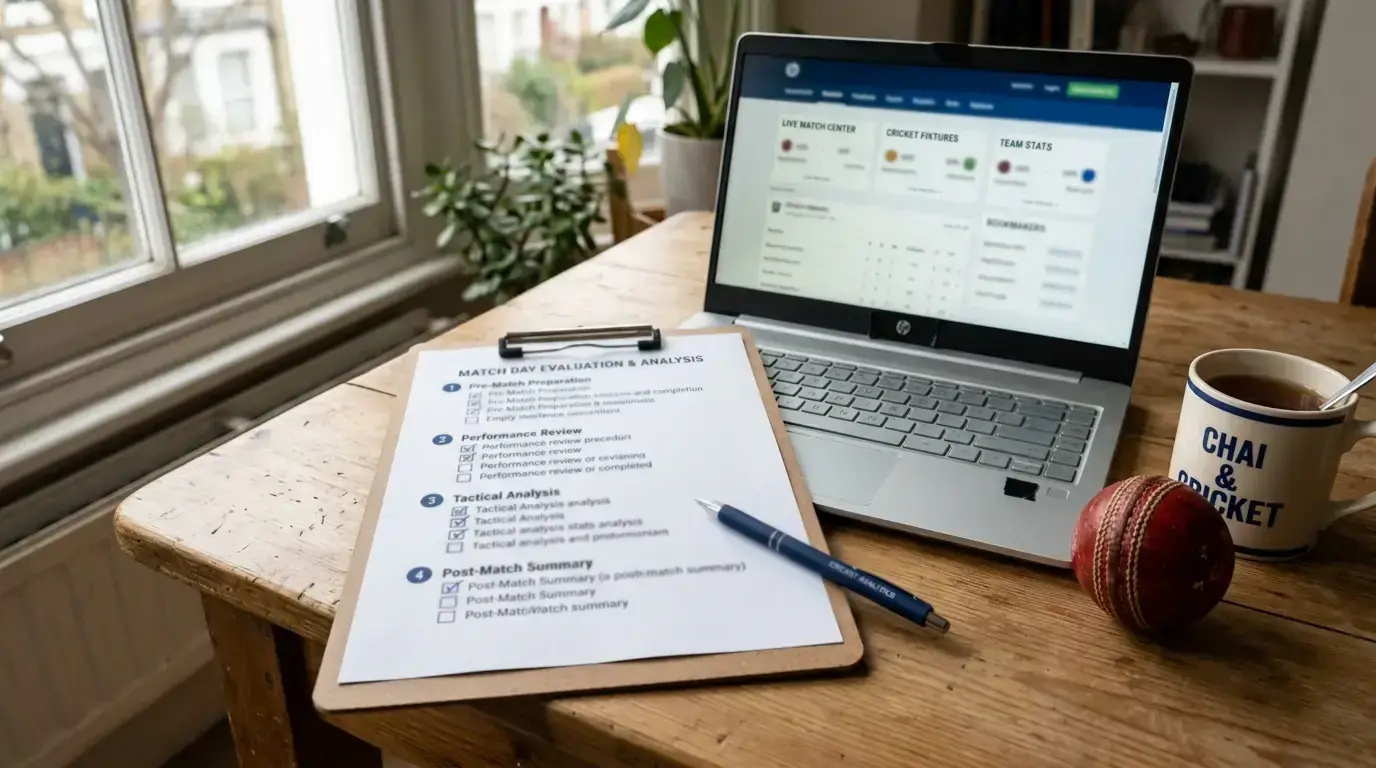
Odds Comparison Methodology: How to Measure What You Are Getting
Most “odds comparison” content you find online consists of a screenshot of three bookmakers’ prices on a single match, followed by an assertion that one is “best.” That is not methodology. It is anecdote. A meaningful comparison requires systematic data collection across multiple matches, multiple markets and multiple time points.
Here is the approach I use. For any competition I plan to bet on regularly — say, the IPL or The Hundred — I record the match winner odds from four to six bookmakers at a fixed time before each match, typically two hours pre-start. I do this for every match in the competition, not just the ones I intend to bet on. Over the course of a tournament with thirty or forty matches, I have a dataset that reveals which platform consistently offers the longest odds on favourites, which platform is sharpest on underdogs and which platforms adjust their odds most aggressively in the final hours before a match.
The metric that matters is the average overround — the bookmaker’s built-in margin across all outcomes in a market. For a two-way T20 match winner market, calculate the implied probability of each side by dividing 1 by the decimal odds, then add the two probabilities together. If the result is 1.05, the bookmaker’s margin is 5%. If it is 1.08, the margin is 8%. Lower overrounds mean better value for the bettor, and the difference between a platform running at 4% margin and one at 7% is significant over hundreds of bets.
I also compare odds movement patterns. Some bookmakers open their cricket markets early with wider margins, then tighten as match day approaches. Others open late with competitive odds that stay stable. If you bet early, the first type penalises you. If you bet late, the second type rewards you. Knowing your bookmaker’s pricing behaviour allows you to time your bets for maximum value, which is an edge that most bettors do not even consider.
The practical constraint is time. You cannot realistically compare odds across eight bookmakers for every market on every match. My compromise is to run a full comparison exercise once per season — covering one complete tournament — and use the results to identify my primary and secondary bookmakers. I then spot-check throughout the season to ensure the pattern holds. If a platform’s odds quality deteriorates noticeably, I rotate it out.

Market Depth by Platform: Who Covers What
I opened an account with a well-known UK bookmaker two years ago specifically because their football product was excellent. When I navigated to their cricket section during the IPL, I found match winner, top batsman and total runs. Three markets. For a tournament with fourteen matches per week, each playable across a dozen different angles, three markets was absurdly thin. I placed one bet and never used the account for cricket again.
Market depth varies dramatically across UK platforms, and the gap is widest in cricket. Cricket is the fastest-growing segment in the global sports betting market, but that growth is not evenly distributed across bookmakers. Some have invested heavily in their cricket product — expanding to cover powerplay runs, method of dismissal, player boundaries, bowler wickets, session totals and a full suite of in-play markets. Others have treated cricket as a secondary sport, offering minimal markets and relying on the assumption that their brand name is enough to attract bettors.
When I assess market depth, I evaluate three dimensions. First, competition coverage: does the platform offer markets for IPL, Big Bash, The Hundred, County Championship, international Tests, ODIs and T20s, and women’s cricket? A platform that covers IPL but ignores the County Championship is not useful for a UK bettor who follows domestic cricket. Second, market range within each match: beyond match winner and top batsman, are player props, over/under, session runs, method of dismissal and exotic markets available? Third, in-play depth: how many of these markets remain available once the match is live? Some bookmakers offer extensive pre-match markets but strip back to match winner and total runs once play begins.
The best way to evaluate depth is to check during a live match, not from marketing pages. Open the cricket section during an IPL evening game and count the available markets. Do the same during a County Championship match on a Wednesday afternoon. The difference will tell you more about the bookmaker’s commitment to cricket than any promotional claim. A platform that offers fifty markets on an IPL playoff and four on a county match is optimised for casual engagement, not for serious cricket bettors.
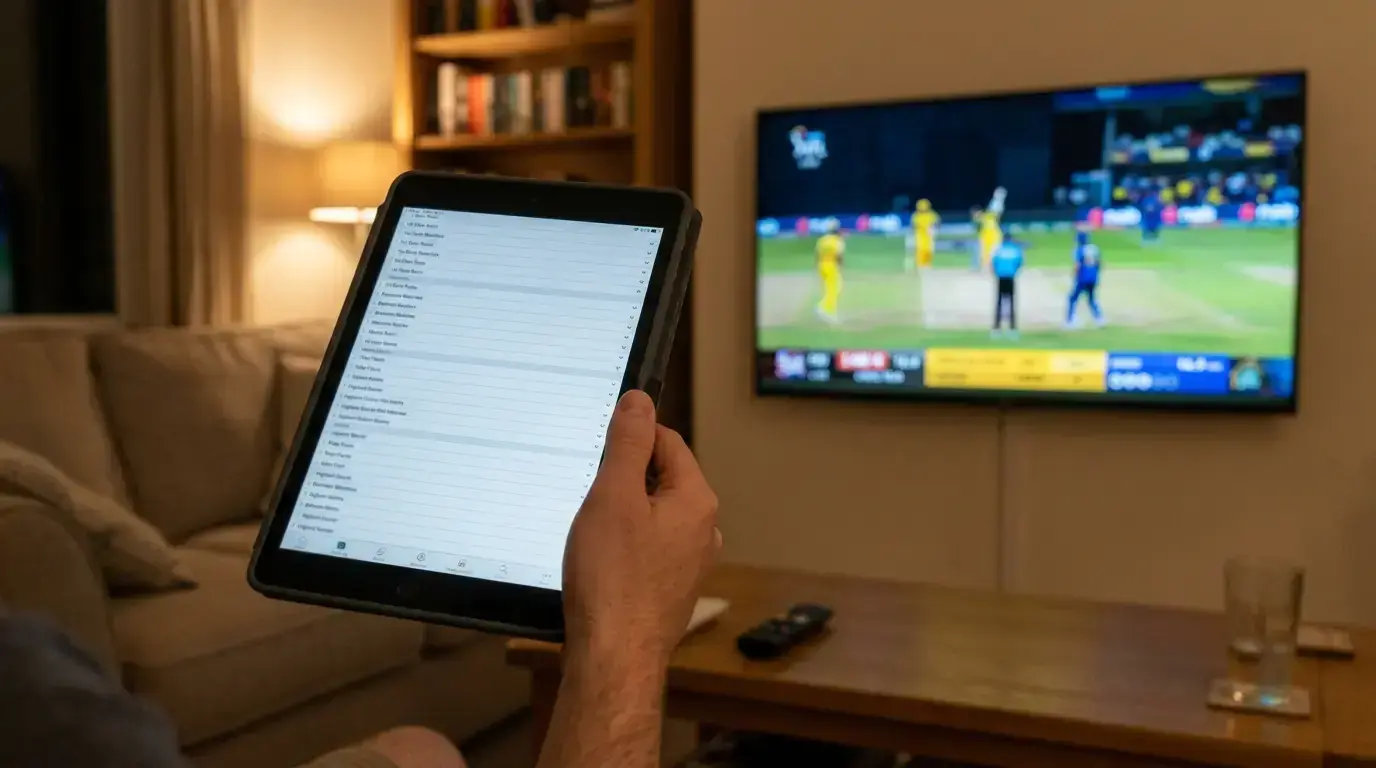
Live Streaming and Cash Out: Features That Affect In-Play Value
In-play betting now exceeds 70% of all online sports wagers in the UK. That figure alone tells you that live features are not optional extras — they are central to the betting experience, and the quality of a bookmaker’s live product directly affects your ability to exploit in-play value.
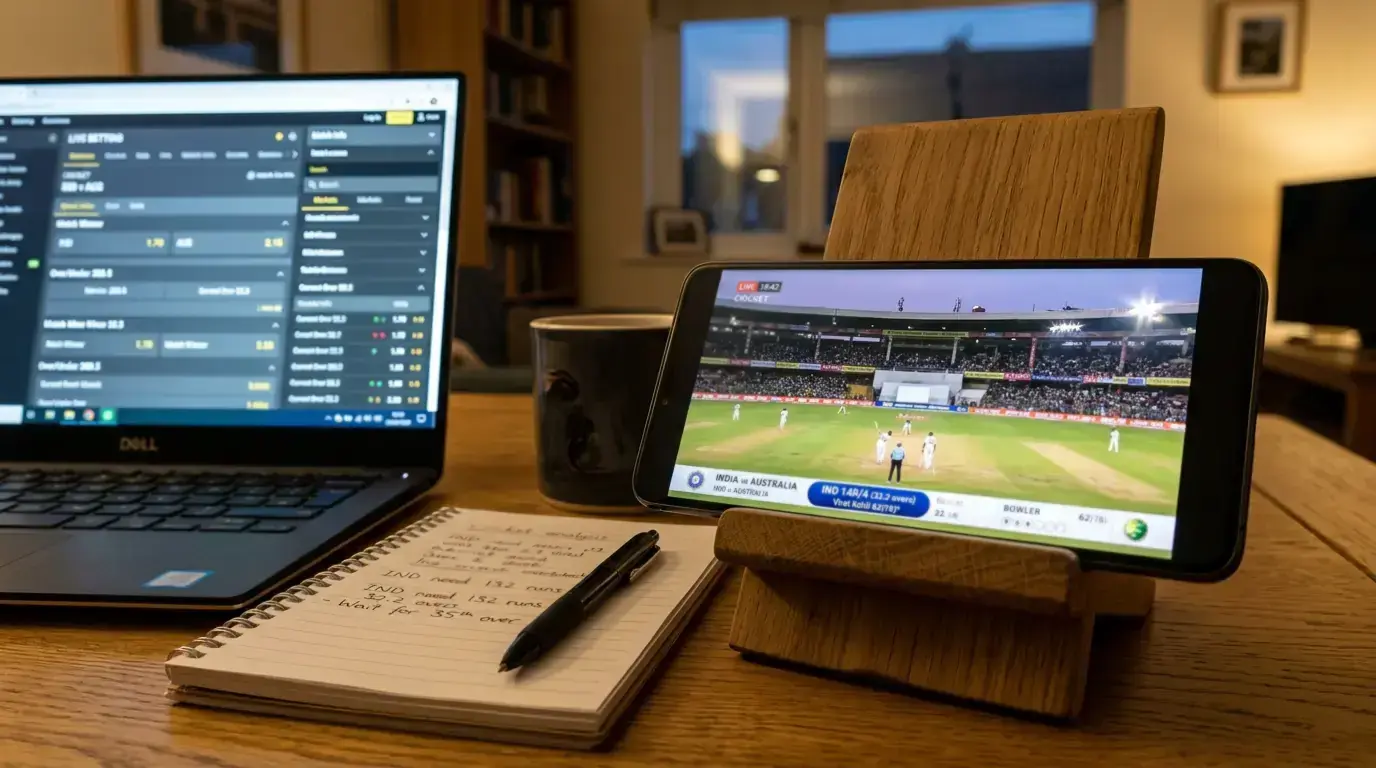
Live streaming is the feature that determines whether you can watch and bet simultaneously on the same platform. Some UK bookmakers stream cricket from major tournaments — IPL, The Hundred, international fixtures — directly within their app or website. Others offer no streaming at all, leaving you to find a separate broadcast and switch between screens. For in-play cricket betting, having the stream and the bet slip on the same interface reduces latency in your decision-making. You see the wicket fall, the odds shift, and you act — all without tabbing between apps. The value of this integration is difficult to quantify in a single bet but compounds meaningfully across a season of live wagering.
Cash out is the feature that allows you to settle a bet before the market has concluded, at a price determined by the current odds. If you backed a team pre-match at 2.50 and they are now at 1.40 with four overs remaining, the bookmaker may offer you a cash-out value that locks in a partial profit without waiting for the final result. The theoretical appeal is clear: you can protect gains or cut losses mid-match. The practical reality is more nuanced. Bookmakers set cash-out prices to favour themselves, meaning the cash-out value is almost always lower than what you would receive if you could sell your bet at true market odds. I treat cash out as an emergency tool rather than a regular strategy. If the match state has changed so dramatically that my original analysis is no longer valid, cashing out might make sense. As a routine profit-taking mechanism, it erodes your edge over time.
The combination of live streaming, in-play market depth and cash-out execution speed creates the overall live experience. Test each element during actual matches before relying on a platform for serious in-play stakes.
Bonuses and Promotions: Reading Past the Headline Numbers
I will be blunt about promotions: they are designed to acquire you as a customer, not to make you a profitable bettor. Welcome bonuses, free bets, enhanced odds and money-back specials all come with terms and conditions that ensure the bookmaker retains the mathematical advantage. That does not mean promotions are worthless, but it does mean they should be evaluated with the same analytical rigour you apply to a bet.
The key term to understand is wagering requirements. A “free bet” of ten pounds typically means you can place a bet of ten pounds and if it wins, you receive the profit but not the original stake. The effective value is significantly less than ten pounds of real money. Enhanced odds — where a bookmaker might offer 6.00 on a selection that should be 3.00 — are usually capped at a small stake and paid as free bet credits rather than cash. The headline looks generous; the reality is a marketing expense for the bookmaker that costs them less than it appears to give you.
Cricket-specific promotions are worth monitoring because they tend to appear around major tournaments: the IPL, The Hundred, the Ashes. A “money back if your top batsman bet loses by one run” offer, for example, has genuine value if you are already planning to bet on the top batsman market. The promotion does not change your analysis — it simply reduces the downside of a bet you would have placed anyway. That is the correct way to use promotions: as a marginal supplement to a strategy that exists independently of any bonus.
What I would caution against is allowing promotions to drive your betting decisions. If you would not have bet on a particular match or market without the promotion, the offer is leading you into a wager you have not analysed. The bookmaker’s promotional department is very good at engineering situations where you feel compelled to act. Your defence is a pre-existing strategy that dictates where and when you bet, regardless of what bonuses are on the table.
Licensing and Trust: The Non-Negotiable Foundation
Everything I have written in this article assumes you are betting with a UKGC-licensed operator. If you are not, none of it matters. An unlicensed bookmaker operates outside the regulatory framework, which means your deposits have no legal protection, your bets may not be settled according to published rules, and your recourse in a dispute is effectively zero.
The UK Gambling Commission oversees an industry that generated £15.6 billion in gross gambling yield during the last reported financial year. The Commission’s enforcement activity has intensified: Andrew Rhodes noted a 300% year-on-year increase in criminal cases pursued, covering betting integrity, cheating and illegal gambling. This is not a passive regulator. Operators that breach licence conditions face fines, restrictions and licence revocations. For the bettor, this enforcement activity is a feature, not a background detail — it means the platforms you use are under genuine scrutiny.
Verifying a bookmaker’s licence takes less than a minute. The Gambling Commission maintains a public register on its website where you can search any operator by name and confirm their licence status, the activities they are permitted to offer and any regulatory actions taken against them. I check this register before opening any new account. A bookmaker that is not on the register is not a bookmaker you should use, regardless of how attractive their odds or promotions appear.

Trust extends beyond licensing to operational behaviour. How quickly does the bookmaker process withdrawals? Do they honour promoted odds without late-stage reductions? Do they restrict or close the accounts of consistent winners? Account restrictions are a widespread practice in the industry and one that affects profitable bettors disproportionately. While no bookmaker is legally obligated to maintain your account, a platform that aggressively restricts accounts after modest winning streaks signals a business model that prioritises recreational losers over informed bettors. This is a factor worth weighing when you choose where to place your long-term betting activity.
Mobile Experience: Where Most Cricket Betting Actually Happens
The vast majority of new bettors now default to mobile or web-based platforms — more than seven in ten by recent industry estimates — and that figure skews even higher among the under-35 demographic that makes up the most active sports betting cohort. If you plan to bet on cricket in 2026, your primary interface will almost certainly be a phone screen. The mobile experience is not a secondary consideration — it is the product.
What separates a strong cricket betting app from a mediocre one is not visual design but functional performance under load. Cricket in-play markets demand rapid interaction: a wicket falls, the odds shift, and you need to get your bet placed within seconds. An app that freezes during peak moments, delays bet confirmation by five or more seconds, or forces you through multiple confirmation screens is an app that costs you money. I test apps during high-traffic events — an IPL evening game, an Ashes morning session — because that is when performance matters most and when poorly built apps fail.
Push notifications are a double-edged feature. Well-implemented notifications can alert you to odds movements, match starts and settlement results. Poorly implemented ones bombard you with promotional messages designed to pull you back into the app. I configure notifications to show match-related alerts only and disable all promotional messaging. The goal is to use the app as a tool, not to let the app use you as a revenue source.

For a more detailed comparison of how individual apps perform on criteria specific to cricket bettors, I have covered that ground in a dedicated review of the best cricket betting apps in the UK that assesses live-bet speed, cricket-specific features and platform differences between iOS and Android.
