

The 2023 Ashes at Edgbaston taught me more about Test match betting than any spreadsheet. England were 2.80 to win on day four morning, the pitch was crumbling, and Australia’s top order looked brittle against reverse swing. I took the position and watched Stokes produce one of the great modern innings. England won by two wickets, and that single bet covered a month of patient waiting. Test cricket rewards patience in a way no other format does — for the teams playing and for the bettors watching. The draw market, multi-day pitch evolution, and session-by-session ebb give you windows that T20 simply cannot offer.
Draw Market Dynamics: The Forgotten Third Outcome
Walk into any conversation about cricket betting and people talk about backing winners. In Test cricket, the draw is the outcome that separates profitable bettors from everyone else. I have tracked draw percentages across Test venues for the past eight years, and the variance is enormous. At the Gabba in Brisbane, draws account for fewer than 10% of results over the last decade. At the Oval in London, that figure rises above 25%. At Galle in Sri Lanka, where pitches turn sharply from day three, draws are rare because the surface forces a result. Knowing these venue-specific draw rates before the match starts gives you a structural edge the market often fails to price correctly.

The draw market tends to open at odds that reflect the historical average for all Test cricket — roughly 20-25% implied probability. But individual matches deviate wildly from that average based on venue, weather forecast, and squad composition. A match at Lord’s between two evenly-matched sides with quality pace attacks, played in September with rain forecast for day three, might have a true draw probability closer to 35-40%. If the bookmaker is still pricing it at 25%, you have a value bet. I have built a draw probability model that incorporates venue history, weather data, bowling attack type (pace-heavy sides create more draws in English conditions), and first-innings scoring pace. It is the single most profitable component of my Test cricket approach.
In T20 cricket, favourites win 60-65% of matches. In Tests, that favourite win rate drops significantly once you account for draws absorbing a share of the probability. A team priced at 1.80 to win a Test match has an implied probability of 55.6%, but if the draw is genuinely 30% likely, only 70% of the probability pie is available for the two win outcomes. That compression means match-winner prices in Tests carry more embedded margin than casual bettors realise. The draw is where the bookmaker hides its profit.

Day-by-Day Pitch Evolution
I flew to Rajkot for the 2024 England tour of India specifically to inspect the pitch on day minus two. What I saw was a surface with visible cracks already forming, black cotton soil that would turn aggressively from day two onward, and minimal grass cover. My model priced India at 1.45 before the market had them at 1.70. The pitch told the story before a ball was bowled.

Test pitches evolve in predictable patterns depending on soil composition, climate, and preparation. Day one typically offers the most for pace bowlers — the surface is fresh, there is residual moisture, and the ball seams. By day two, the pitch settles and batting becomes easier, which is why the first-innings total often sets the tone for the entire match. Day three is the transition: spin starts to grip, cracks widen, and reverse swing becomes viable. Days four and five are survival territory — the surface is at its most unpredictable, and teams batting last face the toughest conditions.
For pitch condition analysis in depth, I have covered soil types and surface behaviour separately. What matters for Test betting is understanding how these daily changes affect odds. The match-winner market should shift significantly between the end of day one and the start of day three, and it does — but not always by enough. If the first innings produces a below-par total because the pitch was lively on day one, the market often overcorrects in favour of the bowling side without accounting for the fact that the pitch will flatten on day two. That overcorrection is a repeatable edge I target across multiple series.
Session Betting: The Test Match Bettor’s Secret Weapon
Forget match winner for a moment. The most profitable Test match market I trade is session runs — the total scored in a specific session (morning, afternoon, or evening). Session betting isolates the micro-conditions that drive scoring: light quality, pitch state at that point in the match, bowling rotation, and even the psychological state of the batting side after a lunch break. Live betting accounts for 55-60% of all cricket bets placed in the UK, and session markets are where much of that in-play volume concentrates in Tests.
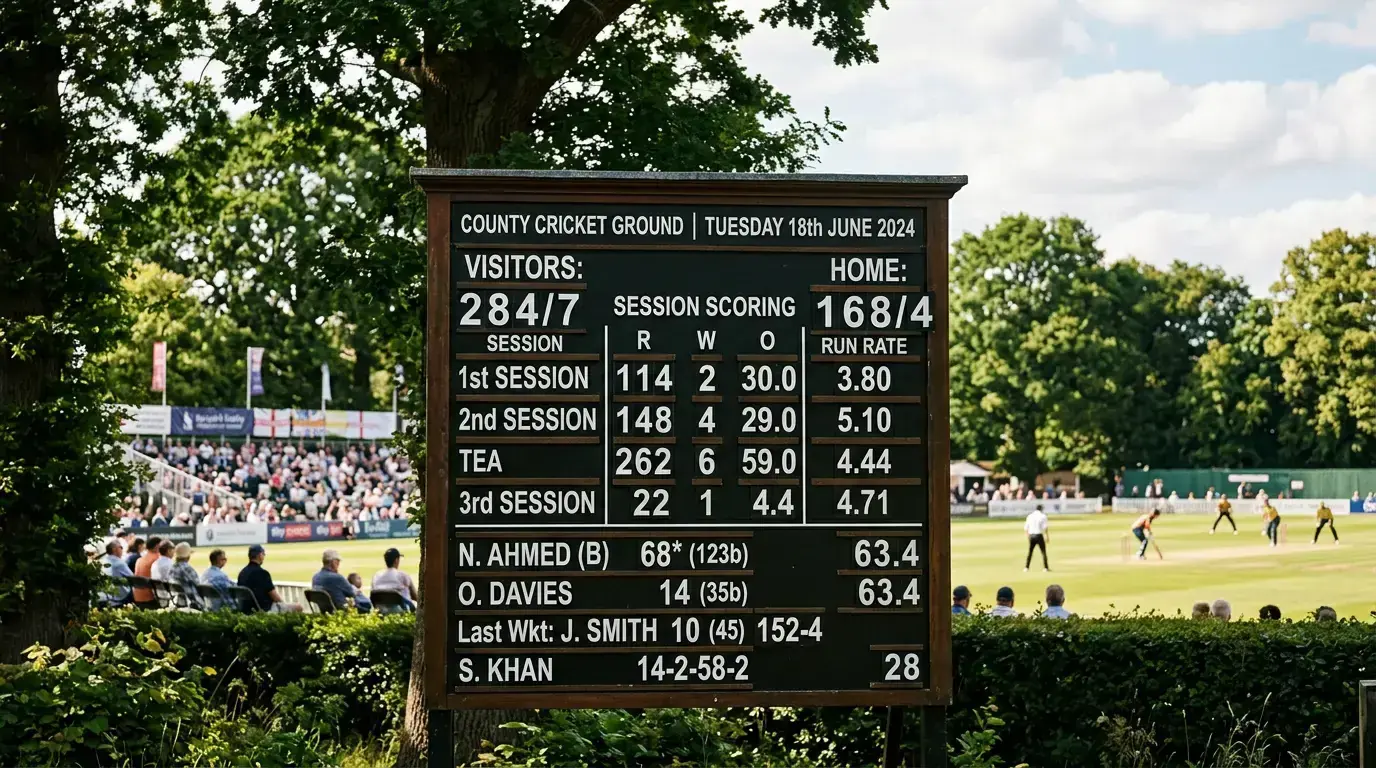
My approach to session runs is straightforward. Before each session, I estimate the expected run rate based on the current match situation: which bowlers will operate, which batsmen are in, how many overs old the ball is, and what the pitch is doing. I convert that estimate to a session total and compare it to the bookmaker’s line. Morning sessions on days one and two typically see lower scoring rates (2.5-3.0 runs per over) because the ball is harder and the light is often overhead. Afternoon sessions accelerate (3.0-3.5), and evening sessions on batting-friendly surfaces can push past 3.5. These patterns are consistent enough across venues that deviations from them signal a mispriced line.
The mistake I see most often in session betting is anchoring to the overall match run rate. A team scoring at 3.8 runs per over across day one is not going to maintain that rate in the morning session of day two if they have lost their top order overnight. Session context overrides match-level averages every time. I maintain separate session models for each phase of a Test match, and the edge comes from recognising transitions — between days, between innings, and between batting partnerships — that the bookmaker’s algorithm smooths over.

Patience as a Betting Strategy
A former colleague of mine used to say that Test cricket is the only sport where doing nothing is a legitimate tactic — for teams and bettors alike. I have come to believe that patience is not just a virtue in this format; it is the strategy. Sportradar’s Andreas Krannich made a point recently that resonates beyond its original context of integrity monitoring: sustained investment in vigilance and intelligence is essential because threats evolve over time. The same principle applies to Test match betting. Conditions evolve over five days. The bettor who waits for the right moment — the end of day two when the draw market is mispriced, the morning of day four when a team’s second-innings collapse shortens the match-winner odds dramatically — will outperform the one who fires off bets before the first ball.
I average two or three bets per Test match, spread across different days and markets. Some matches, I bet only once. Occasionally, I sit out an entire Test because the odds never reach my threshold. That discipline is harder than it sounds when you are watching gripping cricket for five days. But the data is clear: my highest-yield bets in Test cricket come on days three, four, and five, when the match situation has clarified and the remaining uncertainty is narrower but underpriced. The early-match odds carry too much unresolved variance to offer consistent value. Let the match develop. Let the pitch tell you what it wants to do. Then act.