


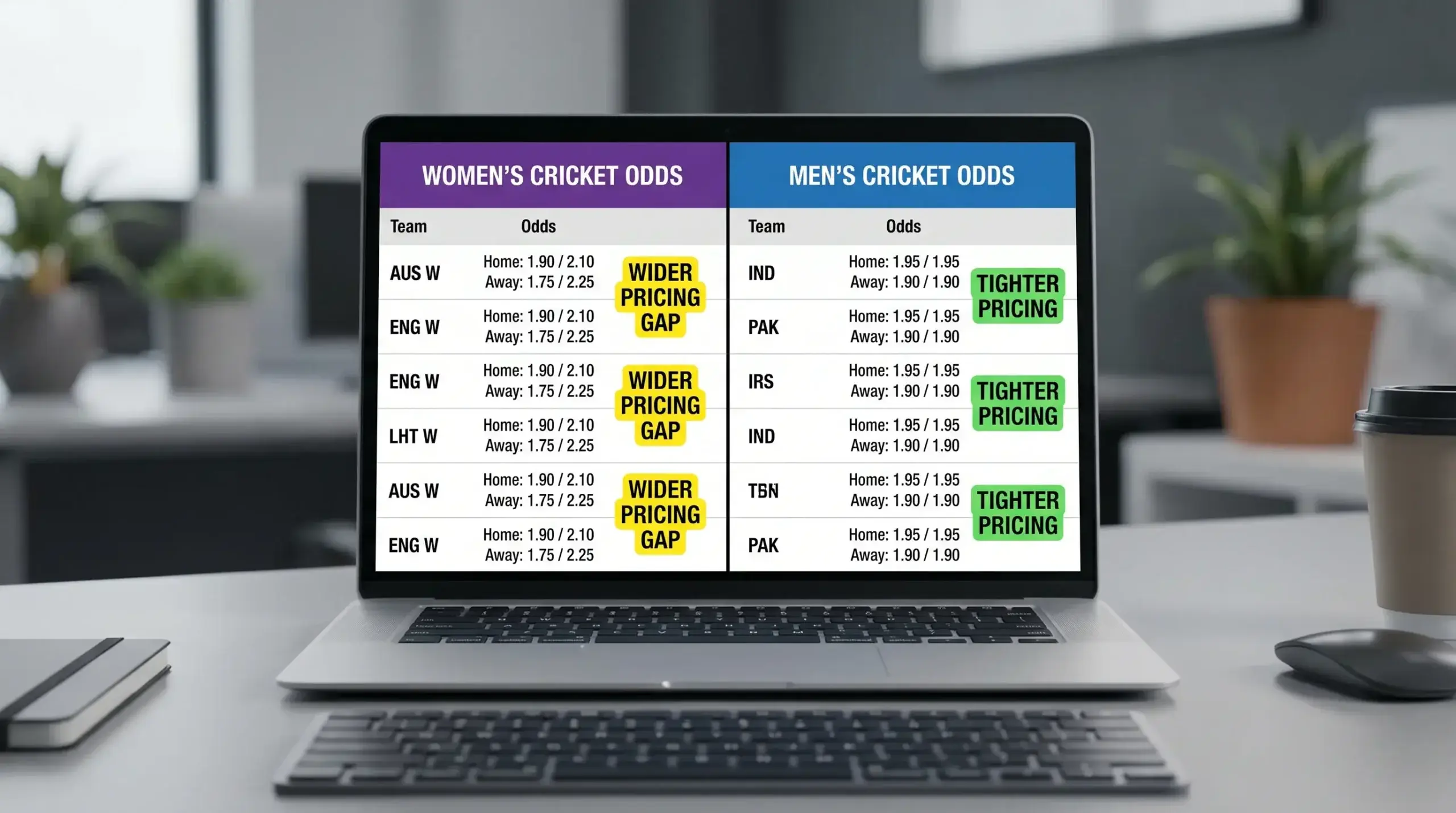
My first serious bet on women’s cricket was a match-winner selection during the 2020 Women’s T20 World Cup. I had built a model using the same framework I use for men’s T20 internationals — venue data, batting matchups, bowling economy splits — and the model flagged a 14% discrepancy between my probability estimate and the bookmaker’s price on a semi-final. That discrepancy would have been unusual in men’s cricket, where the markets are sharp and 5-6% is a good edge. In women’s cricket, 14% was almost routine. The market was thinner, the pricing was lazier, and the analytical infrastructure that compresses edges in men’s markets barely existed for the women’s game. I won the bet, but the real discovery was the market itself.
Why Women’s Cricket Markets Offer Persistent Value
The UK sports betting demographic skews heavily male — 15% of men versus 4% of women place sports bets. That imbalance means the recreational money flowing into cricket markets is overwhelmingly focused on men’s cricket, which is what most recreational bettors watch and follow. Women’s cricket receives a fraction of the betting volume, and lower volume means less competitive pricing. The bookmaker’s algorithm has fewer data points to calibrate against, the odds compilers devote less analyst time to the markets, and the resulting prices are systematically less efficient than their men’s equivalents.

Cricket holds the position of fastest projected CAGR in the global sports betting market, driven by T20 expansion. Women’s cricket is a meaningful part of that growth trajectory — the Women’s Premier League in India, the Women’s Hundred in England, and the expansion of ICC women’s tournaments have all created new betting markets that did not exist five years ago. But the growth in market availability has outpaced the growth in market efficiency. New markets attract new money, but the analytical infrastructure — the models, the data platforms, the specialist tipsters — lags behind. That lag is the value window, and it will not stay open indefinitely as the sport matures.
Dr Dan Plumley, a sports finance expert, noted the growth potential in The Hundred and English cricket more broadly while cautioning that projections from 2029 onwards carry significant uncertainty. That assessment applies to the women’s betting market as well: the opportunity is real today, but the timeline for how long the inefficiency persists depends on how quickly the analytical ecosystem catches up. My approach is to exploit the current softness while building the data infrastructure that will let me maintain an edge as the market tightens.
Scoring Patterns and How They Differ From Men’s Cricket
The most common mistake bettors make when transitioning to women’s cricket is importing men’s scoring benchmarks directly. In men’s T20 internationals, a par first-innings score on a flat pitch is 170-180. In women’s T20Is, the equivalent is 140-155. The difference is not a commentary on quality — it reflects the shorter boundary dimensions typically used in men’s cricket at the same grounds, the greater physical power differential in boundary hitting, and the tactical approaches that have evolved within the women’s game.
Totals markets in women’s cricket are priced off these lower scoring benchmarks, but the variance around the benchmark is wider than in men’s cricket. A dominant batting performance in a women’s T20I can produce 180+, while a bowling-friendly surface can restrict a side to 90. The wider variance means that over/under markets carry more risk but also more reward — a well-analysed conditions read that predicts a high-scoring or low-scoring match has a larger price impact than the equivalent read in men’s cricket, where the scoring range is narrower.
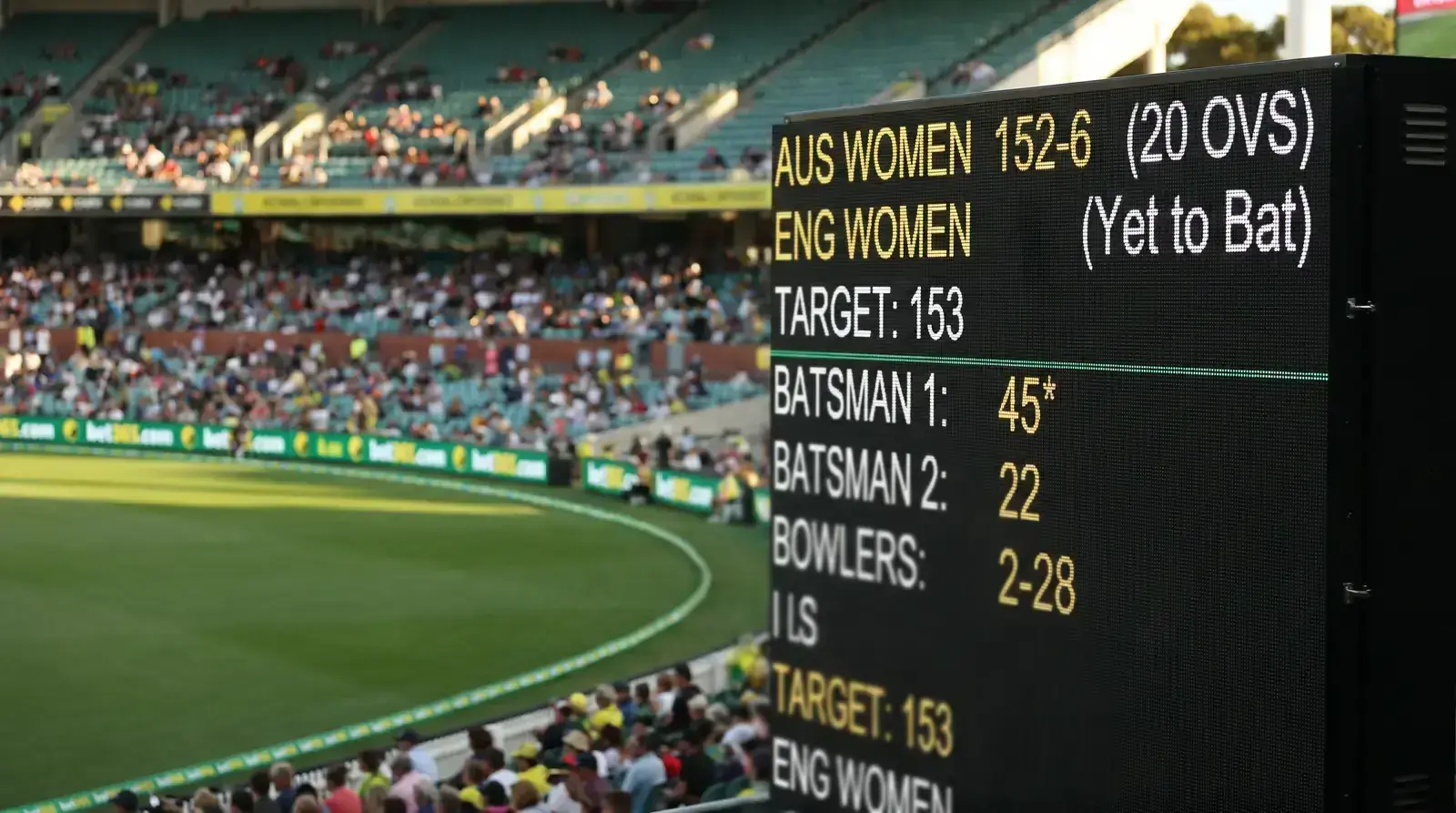
I adjust my models for women’s cricket by recalibrating the par score expectations, the boundary frequency assumptions, and the wicket-fall patterns. Women’s cricket sees fewer sixes per innings but a higher proportion of runs through boundaries off the ground (fours) and running between wickets. The death-over acceleration is less pronounced than in men’s cricket, which means the middle-overs scoring rate carries more weight in projecting the final total. My women’s cricket model weights overs 7-15 more heavily than overs 16-20, which is the opposite of my men’s T20 model.
Where the Lines Are Softest and How to Find Your Edge
The softest lines in women’s cricket are in bilateral series and smaller ICC qualifying events. The Women’s Hundred, the WPL, and the Women’s T20 World Cup attract enough betting volume to produce relatively efficient prices — not as sharp as men’s equivalents, but workable. Bilateral T20I series between, say, England and South Africa, or Australia and India, generate far less volume and carry wider bookmaker margins. The pricing in these markets is set by algorithm with minimal manual oversight, and the algorithm’s inputs are thinner because the historical data for women’s bilateral series is less extensive.

Player prop markets — top batsman, top bowler, player performance — are where I find the most consistent value. The bookmaker’s pricing model for these markets in women’s cricket relies heavily on career averages without the matchup-specific adjustments that sharpen the pricing in men’s cricket. A women’s top-batsman market might price an opener at 4.50 based on her overall average, while my model — which accounts for her record against the specific opposition bowling types and on the specific surface — projects her probability at 28-30%, implying a fair price of 3.30-3.60. That gap is common and repeatable.
The in-play markets for women’s cricket are thinner still. Some bookmakers offer only match-winner in-play during women’s matches, while men’s matches at the same venue carry 30+ in-play markets. When a bookmaker does offer in-play session runs or over-by-over markets for women’s cricket, the pricing is often anchored to men’s scoring benchmarks that have not been adjusted for the women’s game. I have exploited this specific mispricing repeatedly: taking the under on session runs markets that are priced as if the scoring rate will match men’s cricket when the actual women’s run rate is 15-20% lower.

Key Tournaments and Where to Focus Your Analysis
The Women’s T20 World Cup and Women’s ODI World Cup are the flagship events with the deepest markets. I treat these as my primary women’s cricket betting events because the data quality is highest, the bookmaker attention is greatest (meaning the edges are real when I find them rather than artefacts of stale pricing), and the match volume within a concentrated tournament window lets me refine my model across a three-to-four-week period.
The Women’s Hundred runs during the English summer alongside the men’s tournament and has become a significant betting event. The format’s 100-ball structure creates unique pricing challenges that differ from standard T20 — the 25-ball bowling change, the strategic timeout, and the absence of a traditional six-over powerplay all affect scoring patterns in ways that the bookmaker’s T20-calibrated model does not fully capture. I build a separate sub-model for The Hundred’s women’s competition that accounts for these structural differences.

The WPL in India is the newest major women’s franchise league and the one where the market is evolving fastest. In its first two seasons, the pricing was based on very limited historical data and carried wide margins. As the league matures and the data deepens, the edges will compress — but for now, the WPL women’s markets remain among the softest in cricket betting. I prioritise these matches during the Indian season and allocate a meaningful portion of my women’s cricket betting activity to WPL fixtures where my model has enough data to generate confident probability estimates.
