

My first cricket bet was a disaster. Not because I lost — though I did — but because I had no idea what I was doing. I picked England to beat Australia in an Ashes Test because I liked the look of the odds, typed a number into the stake box that felt about right and hit confirm. I could not have told you what the odds format meant, how the market worked or what would happen to my bet if rain washed out a day’s play. I was guessing, and the bookmaker was not.
If you are reading this, you are already doing something I wish I had done twelve years ago: learning the mechanics before placing money at risk. About 10% of the UK adult population participates in online sports betting, and cricket — while smaller than football — has grown into a market that generates real interest and real opportunity. This walkthrough takes you from zero to your first informed bet, one step at a time. No jargon without explanation, no assumptions about what you already know.
The UK Legal Framework: Why You Can Bet on Cricket With Confidence
Before I explain how to place a bet, you need to know that you are operating in one of the most tightly regulated gambling markets in the world — and that is a good thing. The UK’s Gambling Act 2005 established the framework that governs every licensed bookmaker you will encounter. The UK Gambling Commission oversees the industry, issues licences, enforces rules and protects consumers. If a bookmaker holds a UKGC licence, it means they have met stringent standards for fair play, data protection and responsible gambling provisions.
The numbers give you a sense of how large and how well-regulated this market is. Total gross gambling yield across the UK reached a record £15.6 billion during the last financial year. Andrew Rhodes, Chief Executive of the Gambling Commission, has noted that participation in gambling has remained stable at 48% of the adult population — roughly half the country engages with some form of gambling, from the National Lottery to sports betting. Cricket sits within this regulated ecosystem, meaning your deposits are protected, your bets are settled according to published rules and you have access to dispute resolution if something goes wrong.
The practical upshot: you must be eighteen or older to bet on cricket in the UK, you must use a bookmaker licensed by the Gambling Commission, and that bookmaker is legally required to offer you responsible gambling tools including deposit limits, cooling-off periods and self-exclusion options. These are not suggestions — they are legal obligations. Starting within this framework means you are protected from day one.

Choosing Your First Bookmaker: What Actually Matters
When I started, I picked a bookmaker because a friend used them. That is not the worst approach in the world — at least I ended up with a licensed operator — but it is not a strategic one either. The UK market is dominated by a handful of major players: William Hill and Bet365 together account for more than 50% of search click share in the UK sports betting space. They are large, liquid and well-established. But “biggest” does not automatically mean “best for cricket.”
What matters for a cricket bettor is market depth, meaning the range of markets offered on each match. Some bookmakers will give you match winner and top batsman for an IPL game, and that is it. Others will offer you powerplay runs, method of next dismissal, individual player boundaries, session totals and a dozen more options. If you plan to move beyond simple match winner bets — and you should — market depth is the first thing to check.
The second factor is odds quality. Different bookmakers price the same market differently, and over hundreds of bets, consistently getting slightly better odds adds up to a meaningful difference in your returns. I am not suggesting you open accounts with ten operators on day one. Start with one or two, learn the interface, and then expand as your betting matures.
Third, look at the live betting experience. Cricket is a sport that lends itself to in-play wagering — the match state changes with every over, every wicket, every boundary. A bookmaker with a sluggish live platform, delayed odds updates or limited in-play markets will cost you opportunities. Test the platform during a live match before you commit serious money.
Fourth, and this one is easy to overlook: check what responsible gambling tools the platform offers and how accessible they are. Deposit limits, session time reminders and easy access to self-exclusion should be visible in your account settings, not buried three menus deep. A bookmaker that makes these tools hard to find is a bookmaker that does not have your interests at heart. Every UKGC-licensed operator is required to provide them, but the quality of implementation varies.

Account Setup and Verification: Getting Through the Gate
I remember being irritated by the verification process when I opened my first account. They wanted a photo of my driving licence, a utility bill and a selfie. It felt invasive. I understand now that this is one of the most important consumer protections in the system: Know Your Customer checks exist to prevent underage gambling, money laundering and fraud. Every UKGC-licensed bookmaker must verify your identity before you can withdraw winnings, and most will require it before you can deposit above a certain threshold.
The registration process itself takes five to ten minutes. You will provide your name, date of birth, address, email and a mobile number. Choose a strong, unique password — this is an account that will hold real money, so treat it with the same security you would apply to your online banking. Most operators will attempt an electronic identity check using the details you provide, which often completes within minutes. If the automated check fails, you will be asked to upload documents manually.
For manual verification, have a clear photo or scan of a government-issued ID (passport or driving licence) and a recent proof of address (utility bill or bank statement dated within the last three months). Upload quality matters — a blurry photo taken in poor lighting will be rejected and add days to the process. I take verification photos in daylight, on a plain background, and I have not had a rejection in years.
Some bookmakers now require affordability checks for larger deposits or sustained betting activity. This is a relatively recent regulatory development, and while it can feel intrusive, it exists to ensure that you are not betting beyond your means. Cooperate with the process. Trying to circumvent it — by splitting deposits across multiple accounts, for example — will flag your account and potentially lead to closure. The system is designed to keep you safe, and treating it as an obstacle rather than a safeguard is the wrong mindset from the start.
Reading Odds Formats: Fractional, Decimal and What They Tell You
The first time I saw cricket odds displayed as 5/4, I thought it meant something like a cricket score. It does not. Understanding odds formats is the single most important mechanical skill you need before placing a bet, and it is simpler than it looks once someone walks you through it.
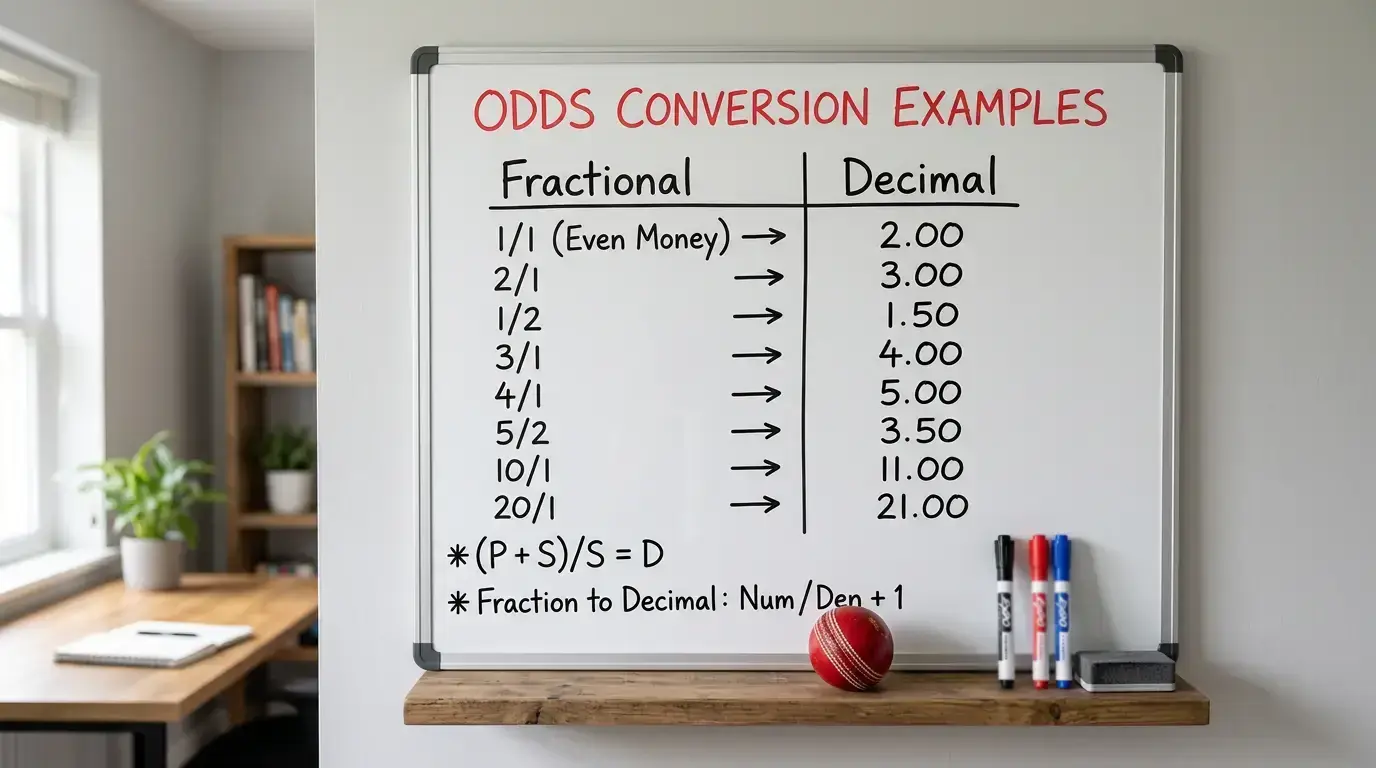
UK bookmakers traditionally display odds in fractional format: 5/4, 3/1, 1/2, 11/8. The first number represents your potential profit relative to the second number, which represents your stake. At 5/4, a stake of four pounds returns five pounds in profit plus your four pound stake back — nine pounds total. At 3/1, a one pound stake returns three pounds profit plus your stake. At 1/2, you need to stake two pounds to win one pound in profit. The pattern is straightforward: the larger the first number relative to the second, the bigger the potential payout — and the less likely the bookmaker thinks the outcome is.
Decimal odds, which are increasingly common on UK platforms and are the global standard, express the total return per pound staked. Odds of 2.25 mean that a one pound stake returns 2.25 pounds (1.25 profit plus your stake). Odds of 1.50 return 1.50 pounds per pound staked (0.50 profit). Converting between formats is a useful skill: decimal odds of 2.25 equal fractional odds of 5/4, and 1.50 equals 1/2. The formula is simple — subtract 1 from the decimal odds and express the result as a fraction.
What odds really represent is the bookmaker’s assessment of probability, with a margin built in for their profit. Decimal odds of 2.00 imply a 50% chance of the outcome occurring (1 divided by 2.00). Odds of 3.00 imply a 33.3% chance. Odds of 1.50 imply a 66.7% chance. This is called implied probability, and understanding it is the bridge between reading odds and making smart bets. If you believe an outcome is more likely than the odds suggest, that is a potential value bet. If you believe it is less likely, the odds are against you regardless of how attractive the payout looks.
Most UK platforms let you switch between fractional and decimal display in your account settings. I use decimal for all my analysis because the maths is cleaner — calculating implied probability, comparing odds across bookmakers and sizing stakes are all easier in decimal. For a thorough breakdown of every format and how to convert between them, I have written a dedicated piece on cricket betting odds explained that covers the mechanics in more detail.
Placing Your First Cricket Bet: A Step-by-Step Walkthrough
You have an account, you understand the odds and there is a cricket match on today. Here is exactly how the process works, step by step — because the mechanics matter more than people think. Over 70% of new bettors prefer mobile or web-based platforms for the convenience and instant data access, and most bookmaker apps are designed to make the process as frictionless as possible. That frictionlessness is both a feature and a risk: it is easy to bet, which means it is easy to bet carelessly.
Open your bookmaker’s cricket section. You will see a list of upcoming and live matches, typically organised by competition (IPL, The Hundred, County Championship, international fixtures). Select the match you want to bet on. The default market displayed is usually the match winner — which team will win. Click or tap on the odds next to your selection, and it will appear in your bet slip, usually a panel at the bottom of the screen on mobile or to the right on desktop.
Enter your stake in the bet slip. Start small. I mean this with absolute conviction: your first bets should be the minimum the platform allows or a pound or two at most. You are learning the system, not trying to make money yet. The bet slip will calculate your potential return based on the odds and your stake. Check that the numbers look right before confirming.
Before you hit “Place Bet,” pause and ask yourself three questions. First, do I understand what I am betting on? A match winner bet means your selection must win the match — a tie, a no-result or an abandoned match will be settled according to the bookmaker’s specific rules, which are published in their terms and conditions. Second, am I comfortable losing this stake entirely? If the answer is no, reduce it. Third, have I done even minimal research on this match, or am I betting on a whim? Whims are expensive habits.
Once you confirm, your bet is live. You can track it in the “My Bets” or “Open Bets” section of your account. If it is a pre-match bet, you wait for the match to conclude. If the bookmaker offers cash-out on that market, you may have the option to settle your bet early at a reduced payout. My advice for beginners: ignore cash-out for now. It introduces decision fatigue and rarely benefits the bettor over the long run. Place your bet, watch the match, and let the result come.

Core Markets for Beginners: Start Here, Expand Later
Cricket offers dozens of betting markets on any given match, and the temptation is to dive into the exotic ones immediately. Resist that. Start with the three markets that are simplest to understand, most widely available and best suited to building your analytical skills.
The match winner market is your starting point. You pick the team you think will win. In limited-overs cricket (T20 and ODI), this is binary — one side wins, one side loses, with no-result as a possible void. In Test cricket, the draw is a third option, which changes the dynamics significantly. Match winner is the most liquid market, meaning it has the tightest odds and the most competitive pricing across bookmakers. It is also the market where learning to assess team quality, conditions and form has the most direct application.
The top batsman market asks you to predict which individual player will score the most runs for their team in the match or innings. This is where basic statistical research starts to pay off. A batsman who opens the innings faces more deliveries and therefore has more opportunity to score runs than someone batting at number seven. Conditions matter too: a top-order batsman who averages 50 on flat pitches but 25 on green seamers is a different proposition depending on the surface. This market rewards the bettor who looks beyond reputation and examines matchup-specific data.
The over/under runs market sets a line — say, 320.5 total runs in an ODI — and asks you to bet on whether the actual total will be higher or lower. This market is attractive for beginners because it shifts your focus from picking a winner to analysing conditions and scoring patterns. A flat pitch, short boundaries and two strong batting lineups push the total higher. A green pitch, overcast skies and quality seam attacks push it lower. You are betting on the nature of the match rather than its outcome, which is a genuinely different skill.
Master these three markets before exploring player props, method of dismissal, session runs or any other specialist market. Each of the three teaches you a different analytical muscle: team assessment, individual performance analysis and conditions reading. Once those muscles are developed, the more complex markets become far less intimidating.

Bankroll Basics: Protecting Your Money From Day One
Here is a truth I wish someone had told me before I placed my first bet: every successful cricket bettor I know started by deciding how much they could afford to lose. Not how much they wanted to win — how much they could lose without it affecting their rent, their bills or their quality of life. That amount became their bankroll, and they never exceeded it.
Set aside a fixed sum that is genuinely disposable. This is money that, if it disappeared entirely, would not cause you financial stress. For some people that is fifty pounds; for others it is five hundred. The number does not matter. What matters is that it is ring-fenced, separated from your everyday spending, and treated as the total capital available for your betting activity.
Once you have your bankroll, apply a simple rule: never stake more than 2-5% of it on a single bet. If your bankroll is two hundred pounds, your maximum stake on any individual bet should be four to ten pounds. This feels slow. It is meant to. The purpose of the rule is to ensure that a losing run — which will happen, no matter how good your analysis — does not destroy your bankroll before you have had enough bets to learn from. Professional bettors typically operate at 1-2% per bet. As a beginner, 3-5% gives you enough skin in the game to stay engaged without risking rapid depletion.
The other essential habit is recording every bet. A simple spreadsheet with columns for the date, match, market, odds, stake, result and profit or loss is sufficient. This record serves two purposes: it keeps you honest about your results (memory is unreliable — you will remember wins more vividly than losses), and it provides the data you need to identify patterns as your experience grows. Start the record from bet number one. Reconstructing it later is tedious and inaccurate.