
The moment that converted me to live betting was the 15th over of a T20 between Rajasthan Royals and Gujarat Titans. Rajasthan were cruising at 120 for 2, the match winner price had them at 1.30 and the in-play market felt settled. Then two wickets fell in three balls. The price lurched to 1.65 within seconds. By the time the dust settled on that over, I had backed Gujarat at odds that reflected a panic the data did not support. Rajasthan’s lower order was stronger than the market priced it, and they won comfortably. That bet was possible only because I was watching the match and the odds simultaneously — and because I had a framework for deciding when a price shift was an overreaction.
In-play betting now accounts for more than 70% of all online sports wagers in the UK, a dramatic expansion from less than 30% just a decade ago. Within cricket specifically, live betting represents roughly 55-60% of all wagers placed. This is not a niche within a niche anymore. It is the market. And it operates under a completely different set of rules than pre-match betting.
How Live Odds Shift: The Mechanics Behind Every Ball
I used to think bookmakers adjusted in-play odds based on some mysterious algorithm that I could never understand. The reality is more intuitive than that, though the execution is sophisticated. Live cricket odds move in response to three things: match events (wickets, boundaries, milestones), the passage of time (overs bowled, overs remaining) and the volume and direction of money flowing into the market. Understanding how these three inputs interact is the foundation of every in-play strategy.
A wicket is the single most impactful event in live cricket betting. When a top-order batsman falls in the first innings of a T20 match, the match winner price shifts immediately — often by 10-20 pence on a decimal scale, sometimes more if the dismissed batsman was the key player. The shift is sharpest early in the innings because fewer overs have been played and the range of possible outcomes is widest. A wicket in the second over changes the trajectory of an innings far more than a wicket in the eighteenth. The bookmaker’s algorithms know this, and the price reflects it.
Boundaries move the needle more subtly. A single six does not transform the market, but a cluster of boundaries across two or three overs can accelerate the scoring rate enough to shift the over/under runs line and the match winner price simultaneously. Watch for the cumulative effect rather than individual balls. If a batsman has hit four boundaries in two overs, the market will recalibrate — but the recalibration often lags by a few balls, creating a window where the price has not yet caught up with the match state.
The time dimension is unique to cricket. In a T20, you know exactly how many balls remain. As overs tick down, uncertainty decreases and the odds compress towards the team in the stronger position. That majority of live cricket wagers is overwhelmingly concentrated in two phases: the powerplay (overs 1-6, where volatility is highest) and the death overs (17-20, where the match outcome crystallises). The middle overs — 7 through 16 — see less in-play activity, which ironically is where pricing inefficiencies are most common. The market is paying less attention during those overs, and that inattention creates opportunity.
Money flow is the third driver. If a large volume of bets comes in on one side, the bookmaker adjusts the price to balance their liability. This is not a signal about match quality — it is a signal about market sentiment. Sharp bettors moving money can shift a price before the match state justifies it, and recreational bettors piling on after a flashy boundary can push a price shorter than it should be. If you can distinguish between price movements driven by match events and those driven by money, you have an edge that most in-play bettors lack.
One pattern I have observed consistently across hundreds of live markets: the odds overreact to the first innings of a T20 or ODI and underreact to the chase. If a team posts 190 in the first innings of a T20, the chasing side’s price drops sharply. But that price often fails to account for pitch deterioration during the break, the dew factor in evening matches or the specific matchup between the chasing team’s top order and the bowling attack they will face. The second innings begins with stale odds more often than the first innings ends with them, and that asymmetry is one of the most reliable patterns I have identified in live cricket betting.
Session and Over Markets: Betting in Smaller Windows
Match winner is the headline in-play market, but it is not where I make the majority of my live profit. Session markets and over-by-over markets are smaller, less liquid, and — crucially — less efficiently priced. The bookmaker devotes the most resources to getting the match winner price right. The session runs line or the six-over runs market receives less algorithmic attention, and that gap is where a prepared bettor can find value.
A session market in Test cricket typically covers one of the three daily sessions: morning (first two hours), afternoon (post-lunch) and evening (the final session of the day). The bookmaker sets a runs line — say, 85.5 runs in the afternoon session — and you bet over or under. The appeal of this market is that it isolates a specific time window, allowing you to factor in conditions that are highly relevant to that period. If the pitch is driest in the afternoon and the batting side has two quality spinners waiting to bowl, the afternoon session might play very differently from the morning.
In T20 and ODI cricket, the equivalent is the powerplay runs market or the over-by-over total. How many runs will be scored in overs 1-6? Will the next over produce more or fewer than 7.5 runs? These markets require you to think in granular terms: the specific bowler about to deliver, the batsman on strike, the phase of the innings, whether the field is up or back. It is a different analytical exercise from assessing which team will win, and it rewards a different kind of preparation.
I treat session and over markets as high-frequency, low-stakes bets. My individual stake on a session market is smaller than on a match winner bet, but I place more of them across a match day. The logic is portfolio-based: each bet carries a small edge, and the aggregate of many small edges compounds into meaningful returns over a season. The risk is overtrading — the temptation to bet every session, every over, every ball. Discipline means passing on markets where you do not have a clear view, even when the platform makes it trivially easy to click.

Reading Momentum: When the Numbers Lag Behind Reality
Momentum is the most overused word in cricket commentary and the most misunderstood concept in live betting. A team scores 18 off an over and suddenly the commentator declares they have “seized the momentum.” But a single explosive over does not rewrite the probability of the match outcome unless it is accompanied by structural change — a set batsman reaching a position of dominance, a bowling attack running out of options or a required rate dropping below run-a-ball.
What I look for is not momentum in the narrative sense but rather a divergence between the match state and the market price. The T20 upset rate of 35-40% tells you that matches swing regularly, and the bookmaker’s algorithms are calibrated to react quickly. But algorithms react to quantifiable events — runs scored, wickets taken, balls remaining. They are slower to price in qualitative shifts like a batsman settling after a scratchy start, a bowler losing confidence in their variations or a fielding side’s body language deteriorating. If you are watching the match and the bookmaker is running a model, you have an informational advantage in the qualitative space.
I have a practical test I use before acting on a momentum read. I ask: has the match state changed in a way that the scoreboard fully captures? If a team is 45/0 after 5 overs, the scoreboard says one thing. But if those 45 runs came entirely from edges and miscued shots that fell in gaps, the underlying quality of the batting is worse than the runs suggest. The next over could bring two wickets. Conversely, if a side is 30/1 after 5 overs but the batsman at the crease is timing every ball cleanly and the bowling attack has no variation left, the scoreboard understates the position. These qualitative reads are the basis of my most profitable live bets — not chasing the last big over.
The danger is confirmation bias. You back a team, and then you see momentum everywhere that supports your position. Every boundary feels like proof you were right; every dot ball feels like bad luck. The antidote is pre-commitment: before the match, I write down the specific scenarios that would trigger an in-play bet, and I stick to that list. If the trigger does not fire, I do not bet, regardless of how the match “feels.”
Format Differences in Live Betting: T20, ODI and Test
Live betting on a T20 match is an entirely different experience from live betting on a five-day Test, and treating them the same way is one of the fastest routes to an empty bankroll. The time horizons, the market structures and the information flow all differ by format.
In T20, the live market moves with extreme speed. A match lasts roughly three hours, with forty overs of action compressed into that window. Prices shift after every ball. Decisions must be made in seconds, not minutes. The powerplay phase in particular — the first six overs of each innings — produces the most volatile price action because the fielding restrictions create higher scoring rates and the small sample of overs amplifies the impact of each wicket or boundary. If your T20 live strategy is not specifically designed for speed and volatility, it is not designed for T20.
ODI cricket gives you more breathing room. Fifty overs per side means the match unfolds over seven to eight hours, and the in-play market has time to settle between phases. The middle overs (11-40) are often the most underpriced phase of an ODI because the scoring rate tends to be steady and unremarkable, lulling both casual bettors and algorithms into complacency. A partnership of 80 runs in the middle overs rarely generates headlines, but it can fundamentally shift the match dynamics and the over/under line.
Test cricket is the format where live betting offers the deepest edges. A match spanning up to five days gives you repeated opportunities to reassess, and the market recalibrates overnight — but not always correctly. The UK Gambling Commission’s Andrew Rhodes has observed that sports beyond traditional horseracing and football are growing in use among UK bettors, with cricket specifically cited as an expanding category. That growth means more liquidity in Test match live markets than existed even three years ago, which in turn means tighter odds and faster price corrections. The window for exploiting in-play value in Tests is narrowing, but it has not closed. The key is to focus your live Test bets on the moments where fresh information arrives fastest — the first hour of each day’s play, when the pitch has had overnight to change character and the overnight batsman must adjust to altered conditions.

Latency and Platform Speed: The Technical Edge You Cannot Ignore
I lost a bet once not because my read was wrong but because the platform took four seconds to process my click. By the time the bet was confirmed, the odds had shifted and I was locked in at a price that offered no value. Four seconds. In live cricket betting, that is an eternity.
Platform speed is a technical factor that most beginners ignore and experienced bettors obsess over. The time between you clicking “Place Bet” and the bet being accepted is called latency, and it varies significantly across bookmakers. Some platforms confirm in-play bets within one second. Others introduce deliberate delays — sometimes five to ten seconds — during which the odds can change. If the odds move against you during that delay, your bet is either rejected or accepted at the new (worse) price. If they move in your favour, the bookmaker may still reject the bet.
Over 70% of new bettors use mobile platforms, and mobile connections are inherently less stable than wired broadband. If you are serious about in-play cricket betting, test your platform’s speed during a live match before committing meaningful stakes. Place a small bet during the powerplay of a T20 and time how long confirmation takes. Do the same during a quiet passage of play. Some bookmakers are faster during low-volatility periods and slower when the market is moving — which is precisely when you most need speed.
The other technical consideration is data feed latency. If you are watching the match on a broadcast that is twenty seconds behind real-time, and the bookmaker is pricing off a live data feed, you are operating with a structural disadvantage. A wicket has already fallen, the price has already moved, and you are still watching the previous over. Minimise this gap by using the fastest available stream or, where possible, in-ground data. Some bookmaker apps display ball-by-ball data that updates faster than their own live streams, which creates the odd situation where reading the scorecard on the app is more informative than watching the video.

Discipline at Full Speed: Managing Your Bankroll In-Play
The 2019 Ashes series taught me what lack of discipline looks like in live betting. I had a profitable pre-match position on England for the Headingley Test. Then Australia took early wickets. I panicked, hedged with a live bet on Australia, and when Stokes produced one of the greatest innings in Test history, I ended up breaking even on a match where my original analysis was correct. The live bet was not analysis — it was emotion.
Online platforms now command roughly 75% of the betting market and are the fastest-growing segment, with growth projections around 10.3% annually. That growth is driven partly by the accessibility of live betting on mobile — you can place a bet from your sofa, your commute, your lunch break. Accessibility is not the same as suitability. The easier it is to bet impulsively, the more important it is to have rules that prevent impulsive decisions.
My live-betting bankroll rules are stricter than my pre-match rules. I allocate a specific sub-bankroll for in-play betting — typically 30-40% of my total cricket bankroll — and I never exceed it within a session. If I hit my daily in-play loss limit, I close the app. No exceptions. I also cap the number of in-play bets per match at a level I set before the match starts. For a T20, that is typically three to four bets. For a Test match day, six to eight across three sessions. These caps prevent the most dangerous behaviour in live betting: chasing a position that has gone against you by throwing more money at an increasingly adverse price.
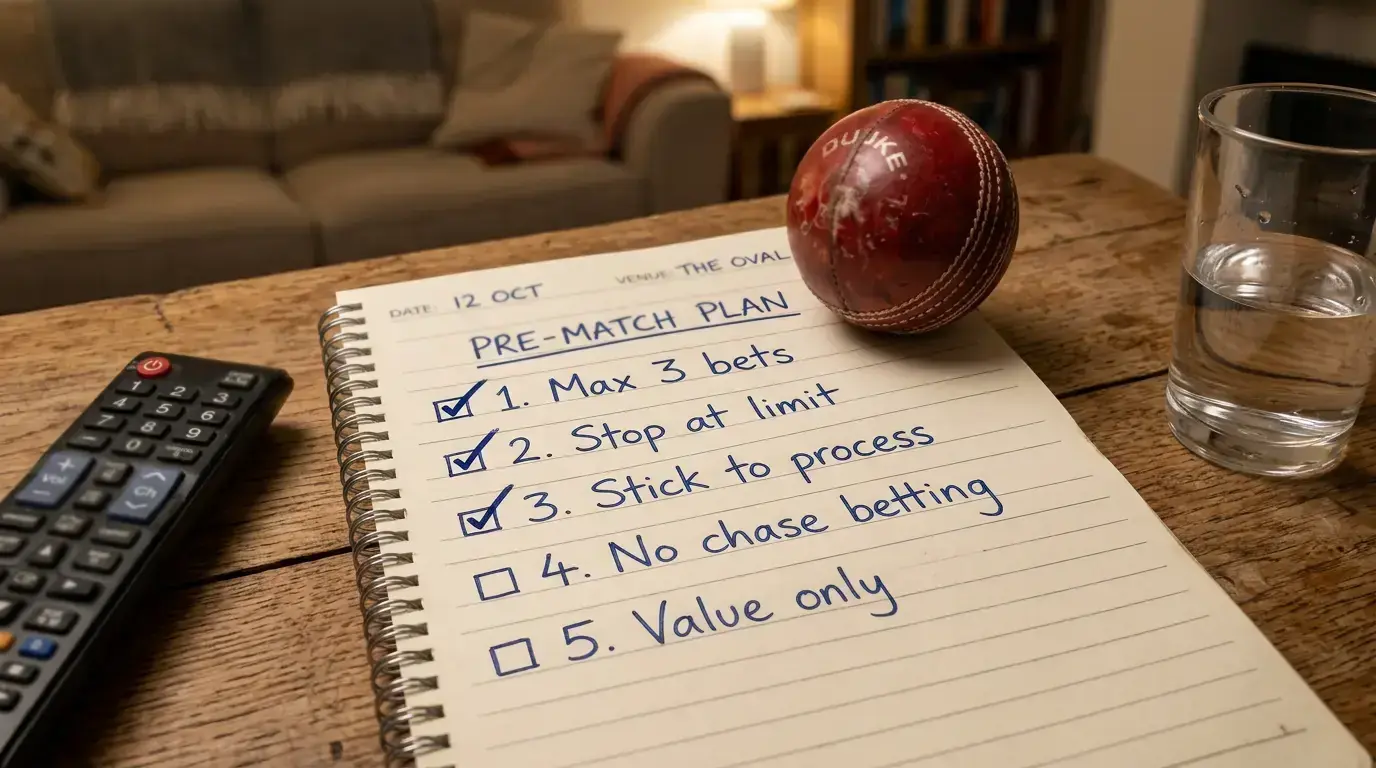
The single best discipline tool for live cricket betting is a written plan. Before the match, write down the markets you are targeting, the price thresholds that represent value and the match scenarios that would trigger a bet. During the match, execute the plan. After the match, review whether you followed it. The bets you did not place are as important as the ones you did.
There is one more rule that took me years to learn: never increase your stake on an in-play bet to recover a loss from earlier in the same match. This is the live-betting equivalent of chasing losses, and it happens faster and more destructively than in pre-match betting because the time between bets can be measured in minutes rather than days. If your first in-play bet on a Test match session loses, the second bet should be sized according to your plan, not inflated to recoup. The match does not know you are behind, and the odds do not care.